













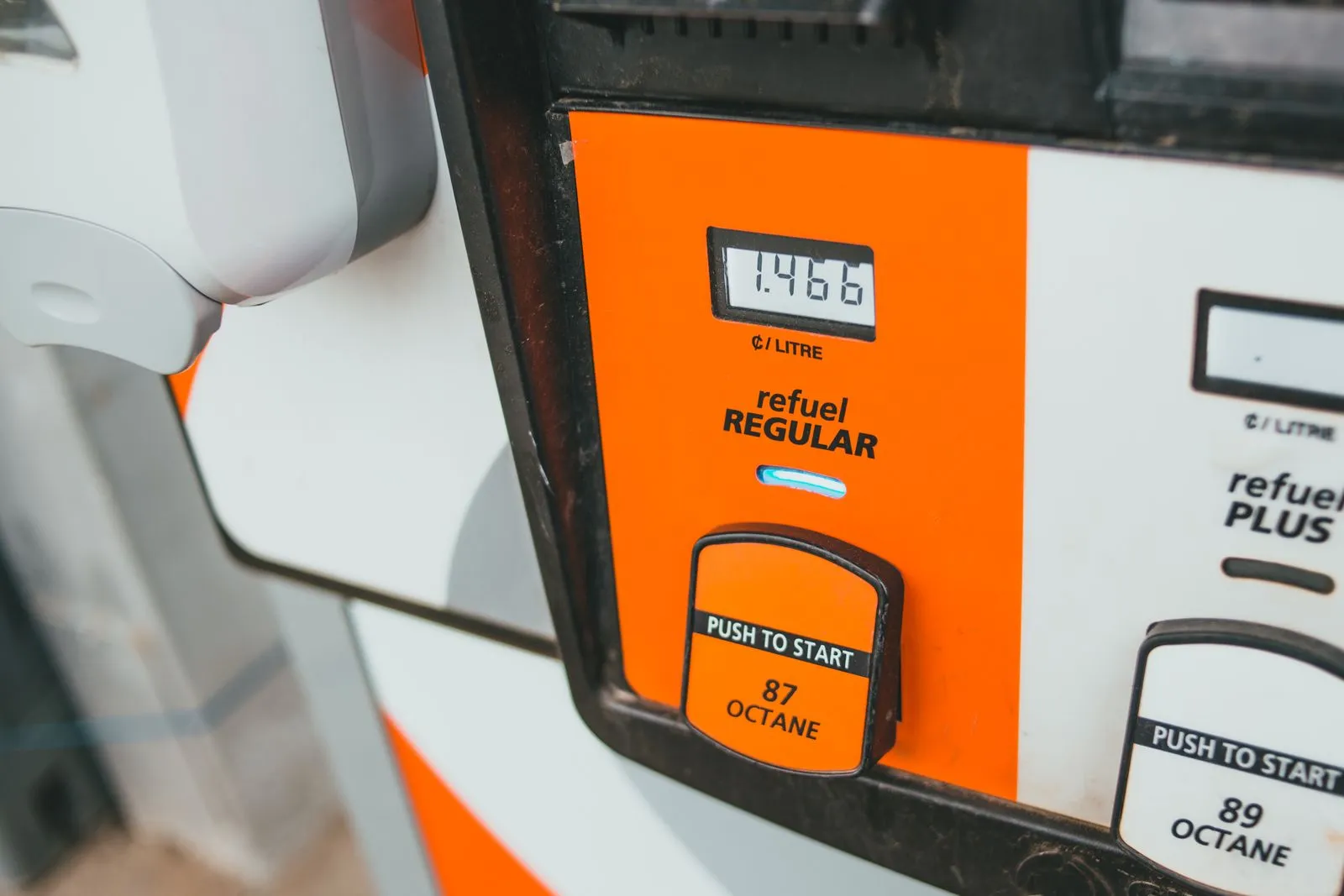
If you filled up on Wednesday, you paid about fifteen cents a gallon more than you did the week before. The AAA national average hit $4.09 as of July 23, up from $3.94 seven days earlier and up sixteen cents on the month. Most states now average $4 or higher.
Oil is why. Volatility along the Strait of Hormuz has pushed crude into the $90 a barrel range, and gasoline follows crude with a two-week lag. Refiners buy the crude, price the gasoline off it, and pass it through at the pump.
Your Fourth of July fill-up is not coming back this weekend.
Here’s what the price coverage skips. The state you fill up in matters as much as the crude price does. California is at $5.57. Indiana is at $3.53. That is a $2.04 spread on the same gallon of gasoline, and most of it is state taxes, refinery rules, and blend mandates. Nobody is coming to fix that.
What it costs you
The typical driver puts 12,000 miles a year on a 25 mpg car. That is 480 gallons. Every dime a gallon adds or cuts is $48 in your budget. The 15-cent jump this week alone, if it holds, is about $72 a year.
Nobody is going to save the whole $72 back with a shopping trick. You can eat most of it. Four moves that work, and a few that don’t.
Do this now
Start with the card in your wallet. The Costco Anywhere Visa pays 4% back on gas and EV charging, up to $7,000 in gas a year. Chase Freedom Flex pays 5% at gas stations through September 30 as its Q3 category, on the first $1,500 in combined bonus spend. Discover it pays 5% on gas this quarter too, same cap. On 480 gallons at $4.09, that is $75 to $95 back a year on any card in the 4 to 5% range. Pick one, put it in your wallet, and stop swiping the flat-rate card at the pump.
Fill up at the warehouse club when you can. Costco and Sam’s Club pump gas 20 to 40 cents below the local branded average in most metros. Membership runs $65 and $50 respectively. If you drive 12,000 miles, a 30-cent-a-gallon discount is $144 a year. The membership pays for itself twice.
Check GasBuddy before you fill. The app is free. Same-neighborhood price spreads of 30 to 50 cents are common, and the branded station on the corner is rarely the cheapest. Two-minute check, real dollars.
Keep your tires at spec while you’re at it. Every 1 psi under the recommended pressure cuts your mpg by about 0.2%, per the Department of Energy. Four tires 5 psi low is roughly a 4% penalty, close to a gallon a week burned pushing soft rubber. Free fix. Check the door-jamb sticker, not the number stamped on the tire.
Not a fix
Buying premium in a car that calls for regular. Filling up at 6 a.m. instead of 4 p.m. (the “cold gas is denser” trick is real, just too small to notice). Idling less in the driveway. All fine. None of them move the number.
Watch the AAA daily average through August. If crude settles back under $80, prices drift down within two weeks. If the Strait of Hormuz stays hot, budget for $4.25 a gallon by Labor Day.
How Candid Yak makes money. Some of the products we write about pay us if you apply or sign up through our links. That never changes our verdict, our rankings, or the numbers in this article. We call a bad deal a bad deal whether it pays us or not. Some brands shown in our comparison tools are placeholder examples while we finalize partner agreements, and we label them as such.